My Coworker Stole My Project and Presented It to the CEO as His Own. I Smiled and Let Him — Because I Knew What Was on the Last Slide.
“This project started as a vision of mine about a year ago,” Brad said, clicking to the first slide. “And I’m proud to finally share it with you.”
I was sitting at the end of the boardroom table on the 34th floor, watching him present my work.
My charts. My research. My eight months of nights and weekends.
His name on the title slide.
My name is Aisha Thompson. I’m 33, a senior analyst at a logistics firm in Chicago, Illinois.
And I had never been so calm in my entire life.
It started in February.
Our company was losing millions on delivery delays. Everybody knew it. Nobody had a fix.
I had an idea. A new routing system, built on data we already had but never used. I spent my evenings building models. My weekends running numbers. I missed my best friend’s birthday dinner. I missed two of my nephew’s basketball games.
By October, I had it. A plan that could save the company eleven million dollars a year.
I was so excited that I made a mistake.
I told Brad.
Brad Callahan was our team lead. Golden boy. Good-looking, loud, played golf with two of the VPs. He’d been at the company six years and had never, as far as I could tell, finished a project on his own.
“This is incredible, Aisha,” he said, scrolling through my files. “Let me take a look this weekend. I’ll help you polish it before we take it upstairs.”
I sent him everything.
On Monday, he said it “needed more work.” He said the CEO wasn’t ready for it.
On Wednesday, I saw it on the executive calendar.
“Q4 Strategy Presentation — Routing Optimization. Presenter: Brad Callahan.”
My name wasn’t anywhere.
I went into the bathroom and shook for ten minutes.
Then I washed my face, and I thought.
I could go to HR. Brad would say it was a team project. HR would say they’d “look into it.” Brad would still give the presentation. And I’d be the difficult woman who complained.
I could confront him. He’d laugh it off. He’d tell everyone I was “emotional.”
Or.
I opened my laptop and looked at the presentation file I’d sent him. The one he was going to use. Forty-seven slides.
He’d added his name to the title slide. He’d changed a few headings. But it was my file. My formatting. My work.
And I knew Brad. Brad never read anything all the way to the end.
On the morning of the presentation, Brad stopped by my desk.
“Hey,” he said with a big smile. “Want to sit in? Could be good exposure for you.”
“Sure,” I said. “I’d love to.”
He winked. “Just watch and learn.”
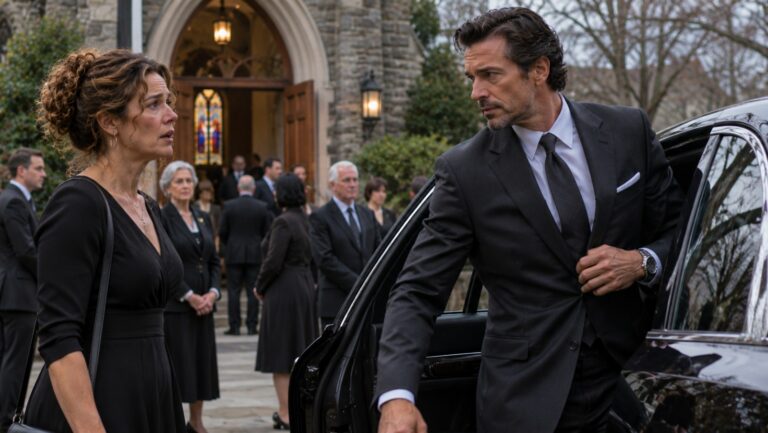
The boardroom was packed. The CEO, Margaret Hollis. The CFO. Four vice presidents. Brad’s golf buddies.
Brad was good at presenting. I’ll give him that. He was confident, funny, and smooth. He’d memorized the big numbers.

“Eleven million in annual savings,” he said, pacing in front of the screen. “That’s not a guess. That’s what the data shows.”
The CEO leaned forward. “Who built the model?”
“I did,” Brad said. “With some help from the team, of course.”
He glanced at me. I smiled back.
He kept clicking.
Slide twenty. Slide thirty. Slide forty.
At slide forty-four, the CFO asked a question about the fuel cost formula.
Brad hesitated. “That’s… a great question. I’ll get back to you on the specifics.”
I could have answered it in my sleep.
Slide forty-five. Slide forty-six.
Then Brad clicked to the last slide.
He didn’t even look at it. He turned to the room with his arms spread wide.
“And that,” he said, “is the future of this company.”
Nobody clapped.
Everyone was staring at the screen behind him.
Slide forty-seven was simple. White background. Black text. I’d made it back in July, the first night I knew the model would work, when I was so excited I couldn’t sleep.
It said:
“Built by Aisha Thompson. Eight months. 1,200 hours. 3 million data points. Thank you for believing in this idea.”
And underneath, in smaller letters:
“Questions about the model? Ask Aisha — she knows every number.”
Brad turned around. He read it. I watched the color drain out of his face.
The room was so silent I could hear the air conditioning.
The CEO looked at the screen. Then at Brad. Then down the table at me.
“Ms. Thompson,” she said slowly. “Is this your work?”
Every head in the room turned toward me.
I’d imagined this moment for three days. I thought I’d feel angry. Or triumphant.
Instead, I just felt steady.
“Yes, ma’am,” I said. “Every slide.”
“I can explain,” Brad said. “Aisha and I worked on it together. It’s a team effort. She must have added that slide as a joke—”
“The CFO asked you about the fuel cost formula,” Margaret Hollis said, without taking her eyes off me. “You couldn’t answer. Ms. Thompson, can you?”
I stood up. I walked to the front of the room. Brad stepped aside like his shoes were on fire.
I explained the fuel cost formula. Then the regional weighting model. Then the three scenarios I’d built for winter weather delays, and why the savings in the Midwest would be higher than on the coasts.
I talked for twenty minutes. Nobody interrupted.
When I finished, the CFO said, “Well. That’s the best answer I’ve heard in this room in five years.”
Brad was moved off the team the next week. A month later, HR announced he was “pursuing other opportunities.”
I was promoted to Director of Operations Strategy. My routing system launched in March.
In its first year, it saved the company $12.4 million. A little more than I predicted.
At the company’s annual meeting, Margaret Hollis gave me an award on stage. Afterward, she pulled me aside.
“Can I ask you something?” she said. “Why didn’t you go to HR when he took your project?”
I thought about it.
“Because people can argue with a complaint,” I said. “But nobody can argue with the work.”
She laughed. “Slide forty-seven.”
“Slide forty-seven,” I said.
I keep a printout of that slide pinned above my desk now.
Every new analyst who joins my team asks about it.
And I always tell them the same thing:
Do the work. Put your name on it. And always, always read to the end.
THE END.
People can steal your work, but they can’t steal what you know. >> Would you have gone to HR, confronted him, or waited for slide 47? Tell us in the comments.