The Gas Station Clerk Refused to Serve Me and Told Me to “Go Beg Somewhere Else.” He Didn’t Know I Was His New Regional Manager.
“We don’t do handouts,” the clerk said, without looking up from his phone. “Go beg somewhere else.”
I was standing at the counter of a gas station in Odessa, Texas, holding a paper cup of coffee and a five-dollar bill.
“I’m not begging,” I said. “I’m paying. It’s a dollar sixty-nine, right?”
He finally looked up. He looked at my dusty boots. My faded jeans with a hole in the knee. The old flannel shirt with paint on the sleeve. My face, which hadn’t seen a razor in three days.
“I said leave,” he said. “Before I call the cops.”
My name is Luis Herrera. I’m 52 years old.
And the next morning, that young man was going to find out who I was.
Let me explain the clothes.
I’d just spent the weekend helping my sister move out of her house in El Paso after her divorce. We’d loaded a truck, painted two rooms, and cleaned out a garage full of thirty years of junk.
Then I got the call.
“Luis, we need you in Odessa first thing Monday,” my boss said. “The regional manager quit. The Permian Basin stores are a mess. You’re it.”
I’d worked for Lone Star Fuel & Market for twenty-six years. I started as a night cashier when I was twenty-six, in a store just like that one. I’d worked my way up to district manager.
Now I was in charge of forty-two stores across West Texas.
I didn’t even have time to go home and change. I just drove six hours across the desert in my sister’s moving clothes, and around 11 p.m., I pulled into the first store on my list for a coffee.
Store number 118.
There was an older woman stocking shelves near the back. Her name tag said “Gloria.” She’d watched the whole thing.
As I walked toward the door, she caught my arm gently.
“Here, mijo,” she whispered. She pressed two dollars into my hand. “For the coffee. Don’t mind him. He’s like that with everybody who looks tired.”
“Everybody?” I asked.
She sighed. “Truckers. Field workers. Anybody who doesn’t look like they’ve got money. He’s run off half our regulars.”
I looked at the two crumpled dollar bills in my hand. This woman, who probably made thirteen dollars an hour, was giving her money to a stranger she thought was homeless.
“What’s your name?” I asked.
“Gloria,” she said. “Gloria Medina. Twelve years at this store.”
“And his?”
She rolled her eyes. “That’s Tanner. The manager’s nephew.”
I didn’t sleep much that night in my motel room.
I opened my laptop and pulled up store 118’s numbers. Sales down thirty-one percent in the last year. Customer complaints tripled. Three employees quit in six months.
And the store manager, Dale Pruitt, had marked his nephew Tanner as “Employee of the Month” four months in a row.
I read the customer complaints one by one.
“Clerk refused to sell me gas because he said my card was ‘probably stolen.’ It wasn’t.”
“Told my husband, a disabled veteran, to stop ‘loitering’ when he was waiting for me in the car.”
“Called my teenage son a thief in front of everyone. He was buying a soda.”
Every complaint had the same name in it.
Tanner.
At 7 a.m., I shaved. I put on a pressed white shirt and my company name badge. I picked up my clipboard.
And I walked back into store 118.
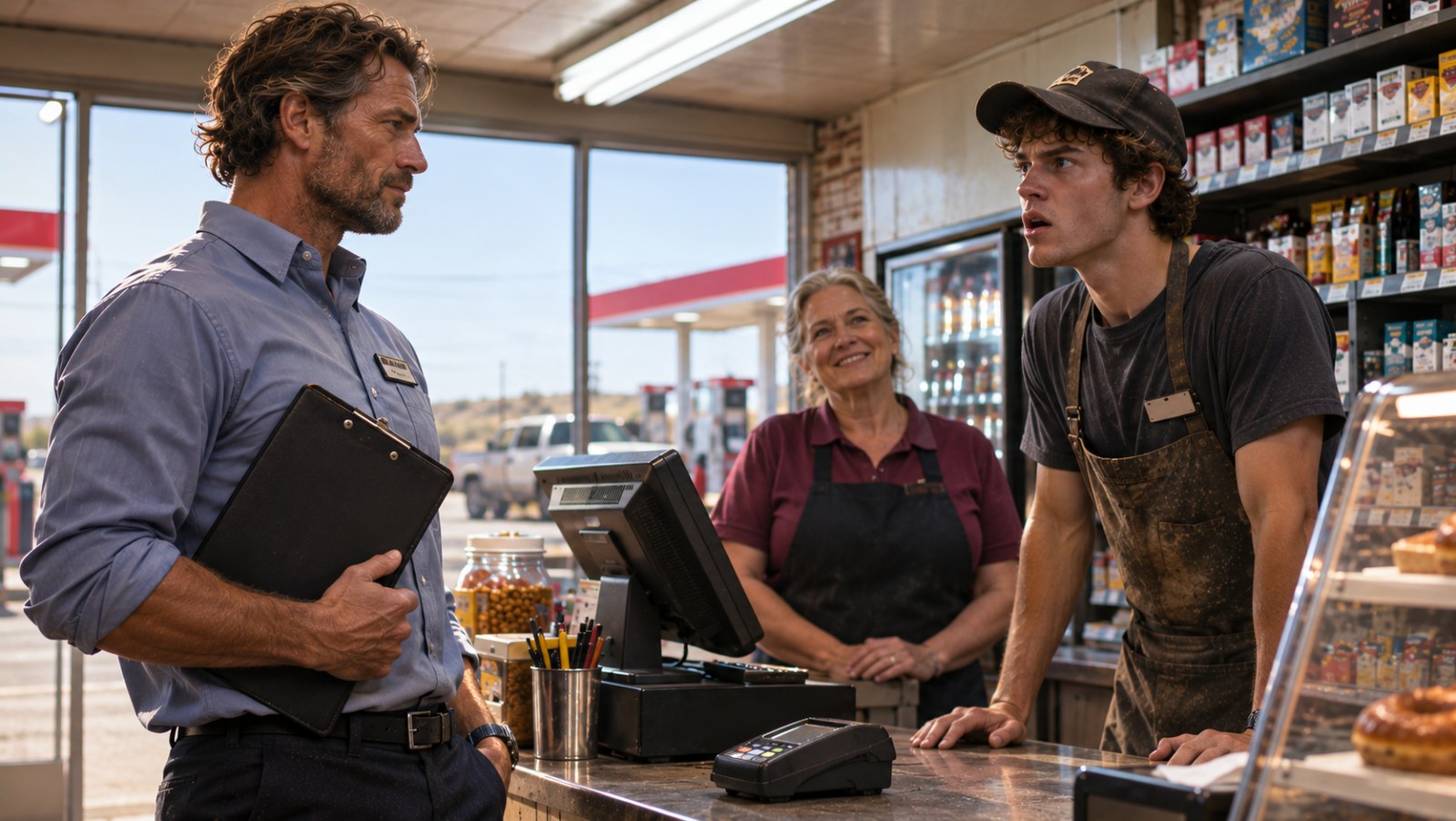
Tanner was behind the counter, scrolling on his phone. He looked up and gave me the customer smile — the one he hadn’t given me the night before.
“Good morning, sir! Welcome to Lone Star. What can I get you?”
He didn’t recognize me.
“Coffee,” I said. “And I’d like to speak with the manager, please.”
“Uncle Dale’s not in till nine,” Tanner said. “Can I help you with something?”
I set my clipboard on the counter.
“Maybe,” I said. “Last night around eleven, a man came in here to buy a coffee. You told him to go beg somewhere else. You threatened to call the police.”
Tanner’s smile froze.
“I don’t… I don’t remember that,” he said.
“I do,” I said. “That was me.”
I tapped my name badge. “Luis Herrera. Regional Manager. Starting today.”
I’ve seen a lot of faces go pale in twenty-six years. Tanner’s went paler than most.
“Sir, I… I didn’t know. I’m so sorry. If I’d known who you were—”
“That’s the problem,” I said. “You shouldn’t need to know who somebody is to treat them like a person.”
From the back of the store, I heard a soft gasp.
Gloria was standing by the coffee station with a box of stir sticks in her hands, staring at me with her mouth open.
“Mijo?” she whispered.
I smiled at her.
“Thank you for the coffee last night, Mrs. Medina,” I said. “I owe you two dollars.”
Dale Pruitt arrived at 8:15. Somebody had called him.
He tried to explain. He said Tanner was “young.” That he was “learning.” That he’d “talk to him.”
“You marked him Employee of the Month four times,” I said, holding up the report. “While your sales dropped by a third and your customers filed thirty-eight complaints. You weren’t teaching him. You were protecting him.”
I didn’t yell. I’ve never needed to yell.
By noon, Tanner was gone. Dale was put on a performance plan and transferred to a smaller store in Monahans, where I’d be checking in personally every month.
And store 118 needed a new manager.
I called Gloria into the back office.
She sat down nervously, smoothing her apron like she was the one in trouble.
“Mrs. Medina,” I said, “how would you feel about running this store?”
She stared at me. “Me? I don’t have a college degree. I just stock shelves and run the register.”
“I didn’t have a degree either,” I said. “I started as a night cashier. Twenty-six years ago, a manager in Lubbock took a chance on me because she saw me give my lunch to a trucker who couldn’t afford his.”
I slid the paperwork across the desk.
“Last night, you gave your money to a stranger you thought had nothing. That’s exactly who I want running my stores.”
Gloria put her hand over her mouth and started to cry.
It’s been a year since then.
Store 118 has the highest customer satisfaction score in all of West Texas. Sales are up forty-four percent. The truckers came back. The field workers came back. The disabled veteran and his wife come in every Saturday morning for coffee.
Gloria put up a handwritten sign next to the register on her first day as manager. It’s still there.
“Everyone who walks through this door is a guest. No exceptions.”
And taped underneath it, in a little plastic sleeve, are two crumpled dollar bills.
I paid her back. She refused to take the money.
So we framed it instead.
THE END.
Treat everyone with respect — you never know who’s standing in front of you, and it shouldn’t matter. >> Have you ever been judged by how you looked? Tell us what happened in the comments.