The Janitor at My Son’s School Ate Lunch Alone in a Supply Closet for 19 Years. On Graduation Day, 312 Seniors Stood Up When He Walked In.
“Please welcome to the stage… Mr. Raymond Dupree.”
The gym went quiet. A few parents looked at each other, confused.
Then, in the third row, a girl stood up.
Then a boy behind her. Then ten more. Then fifty.
By the time a small gray-haired man in a janitor’s uniform reached the end of the aisle, all 312 seniors of Hale High School were on their feet, clapping so hard the bleachers shook.
My name is Denise Hollis. I’m 44, and I live in Tulsa, Oklahoma.
I was sitting in the bleachers that day with my mother, waiting to watch my son, Jordan, walk across the stage.
I had no idea who Mr. Ray was.
By the end of that afternoon, I’d never forget him.
To understand that moment, you have to understand Jordan’s freshman year.
His dad left that August. Moved to Phoenix with someone new and stopped calling by Thanksgiving. I was working double shifts at the hospital. Jordan was fourteen, angry, and completely alone.
His grades crashed. He stopped talking to me. Every morning, I dropped him off at school and drove away feeling like I was losing him.
Then, sometime around February, things started to change.
His grades went up. Slowly at first. Then a lot.
He started eating dinner with me again. He started saying “please” and “thank you” in a way he hadn’t since he was little.
When I asked what happened, he shrugged.
“I eat lunch somewhere else now,” he said.
That’s all he’d tell me.
At graduation, sitting in those bleachers, I watched my son stand up and clap for a man I’d never met — and cry.
Jordan doesn’t cry. Not at his grandpa’s funeral. Not when his dad left.
But there he was, in his blue cap and gown, wiping his face with his sleeve.
The principal, Mrs. Okafor, waited for the applause to die down. It took almost three minutes.
“For nineteen years,” she said into the microphone, “Mr. Ray has kept this building running. Most of you know him as the man who fixes the lockers and mops up your spilled Gatorade. But the senior class asked me to tell you about something else.”
She looked down at a piece of paper. Her voice wobbled.
“They asked me to tell you about the closet.”
There was a supply closet on the second floor of Hale High, next to the science labs.
Inside, among the mops and paper towels and boxes of chalk, there was a folding chair and a tiny card table.
Mr. Ray ate his lunch there every day. Alone. A sandwich in wax paper and a thermos of coffee.
One day in 2006, a freshman boy who was being bullied hid in that closet to cry. Mr. Ray didn’t kick him out. He just pulled a second chair off a shelf, unfolded it, and said, “You like peanut butter?”
The next day, the boy came back.
And that’s how it started.
Over nineteen years, Mrs. Okafor said, Mr. Ray’s closet became something nobody ever officially knew about.
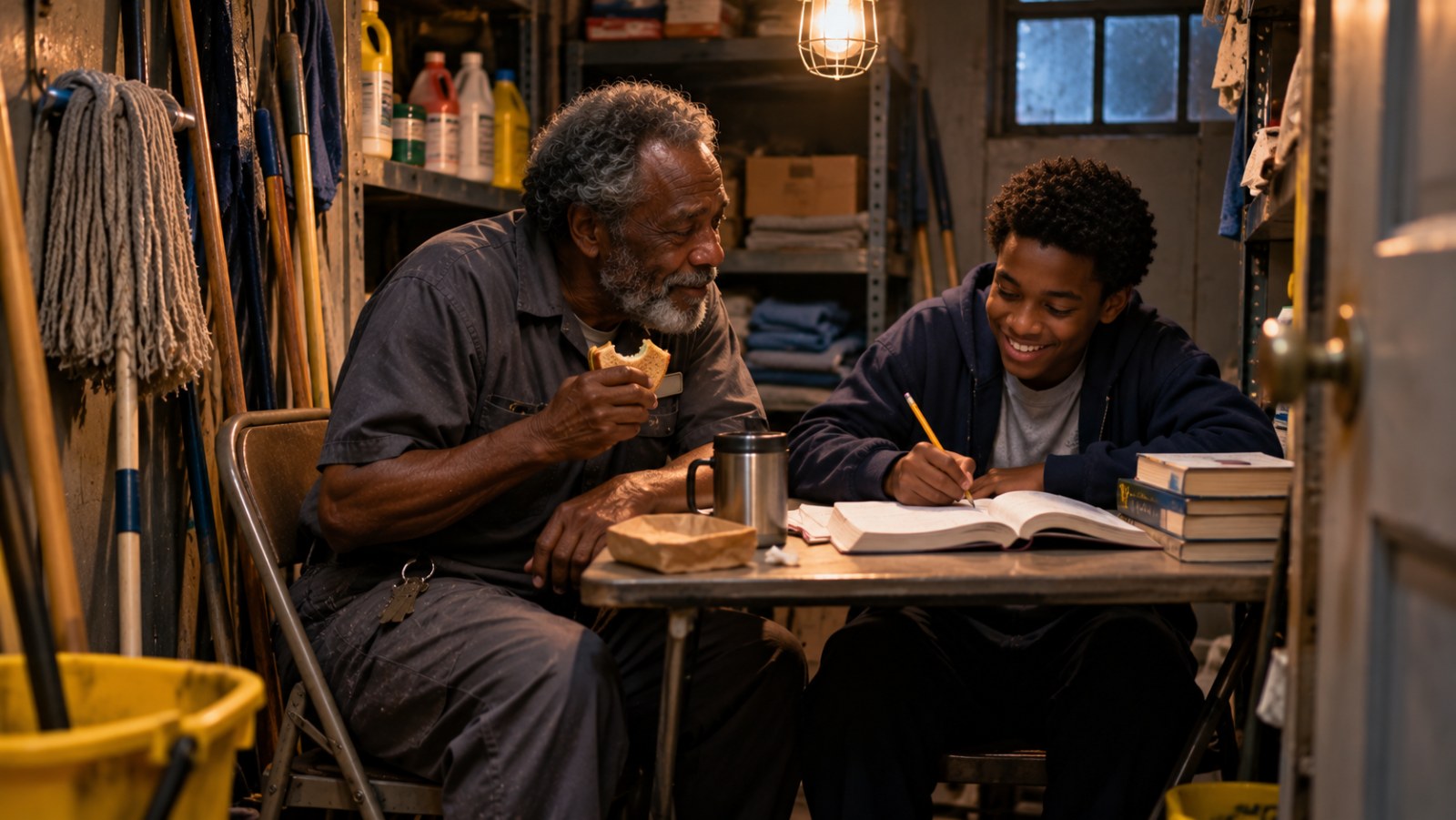
A place for kids who didn’t have anywhere else to sit.
The new kid who didn’t speak English yet. The girl whose mom was in rehab. The boy who’d just come out to his parents and gotten kicked out. The kid whose dad left for Phoenix.
Mr. Ray never gave speeches. He never asked a lot of questions. He just made room.
He kept extra sandwiches in a cooler. He kept a box of donated winter coats behind the mop buckets. He’d learned enough algebra over the years to help anybody who was stuck. And on the wall, he had a sign written in marker on a piece of cardboard:
“YOU ARE NOT IN TROUBLE. YOU ARE JUST HAVING LUNCH.”
I was crying so hard by then that my mother had to hand me tissues.
Because I finally understood where my son had been eating lunch.
Mrs. Okafor went on. “Over the last four years, the seniors started counting. They passed around a notebook. They asked every student who had ever sat in that closet to write their name.”
She held up a spiral notebook. It was thick, the pages warped from use.
“There are a hundred and forty-seven names from this class alone,” she said. “And when the alumni heard about it, they started writing in too. As of this morning, there are more than nine hundred.”
The gym was completely silent.
“Mr. Ray, nine hundred kids had somewhere to sit because of you. Some of them are here today.”
That’s when the side doors of the gym opened.
People started walking in. Dozens of them. Adults. Some in work clothes, some in suits, one in a military uniform, one holding a baby.
They lined up along the wall behind the stage.
Mrs. Okafor read off a few of their names.
A nurse. A firefighter. A software engineer. A math teacher at Hale — who’d been the first kid in the closet, back in 2006.
He walked up and hugged Mr. Ray so hard he lifted him off his feet.
Mr. Ray just stood there in his gray uniform, shaking his head over and over, like he couldn’t believe any of it was real.
Then the senior class president, a girl named Tasha, walked up with an envelope.
“Mr. Ray,” she said, “we found out you never finished school. You had to quit at sixteen to take care of your little brothers.”
He nodded slowly.
“So we wanted to give you something you gave all of us.”
She handed him the envelope. Inside was a diploma. A real one. Mrs. Okafor had worked with the school district for months to arrange an honorary diploma.
On the bottom, under the signatures, the seniors had added one line:
“Raymond Dupree — Class of Every Year.”
The old man held that piece of paper against his chest and cried.
The whole gym cried with him.
When he finally stepped to the microphone, his voice was so quiet that everyone leaned forward to hear.
“I didn’t do anything special,” he said. “I just didn’t like eating alone.”
Then he looked out at all of those kids in their caps and gowns.
“Neither did any of you.”
After the ceremony, I found Jordan in the parking lot. He was standing next to Mr. Ray, who was holding his new diploma in a plastic sleeve like it might blow away.
“Mom,” Jordan said, “this is Mr. Ray. He’s the one who helped me with algebra.”
I shook his hand. Then I didn’t let go.
“You fed my son,” I said. “When I couldn’t be there. When his father wasn’t there. You fed him.”
Mr. Ray smiled.
“He fed me too, ma’am,” he said. “He brought me your banana muffins every Friday for three years. Best muffins I ever had.”
I looked at my son. He turned bright red.
I had always wondered where half the batch went.
Mr. Ray retired that summer.
On his last day, the school installed a small brass plaque on the door of the second-floor supply closet. Students voted to keep the folding chairs and the card table inside.
The sign is still on the wall, in his handwriting.
“YOU ARE NOT IN TROUBLE. YOU ARE JUST HAVING LUNCH.”
Jordan is in college now. Studying to be a teacher.
He says when he gets his own classroom, the first thing he’s going to buy is a second folding chair.
THE END.
You never know whose whole life you’re saving just by making room at the table. >> Was there a “Mr. Ray” in your school who changed your life? Tell us about them in the comments.