A Teenager Returned My Lost Wallet With $600 Still Inside. I Asked What He Wanted. He Said, “Can You Help Me Read This Letter?”
“Ma’am? I think this is yours.”
The boy on my front steps was holding out my wallet.
I had lost it two days earlier, somewhere between the pharmacy and the bus stop. My driver’s license, my credit cards, my late husband’s photo, and $600 in cash I’d just withdrawn to pay my property taxes.
I’d already canceled the cards. I’d already cried about the photo. I’d already given up on the money.
My name is Carol Jensen. I’m 66, a retired high school English teacher, and I live in a little bungalow in Bay View, Milwaukee.
And standing on my porch was a skinny kid in a worn gray hoodie, maybe sixteen, holding my wallet like it was made of glass.
I opened it right there. Everything was inside. My license. Frank’s photo. And every single twenty-dollar bill. Thirty of them.
“Oh my goodness,” I said. “Thank you. Thank you so much. Where did you find it?”
“By the bus stop on Kinnickinnic,” he said. “In the gutter. I got your address off your license.”
“You walked all the way here?”
He shrugged. “It’s only like two miles.”
I pulled out two of the twenties and held them out. “Please. Let me give you a reward.”
He shook his head. “No, ma’am. I’m good.”
“Then come in. At least let me make you a sandwich.”
He hesitated. Then his stomach growled so loudly that we both laughed.
“Okay,” he said. “Thanks.”
His name was Marcus Webb. He was sixteen. He lived with his grandmother in an apartment over a laundromat on Kinnickinnic Avenue.
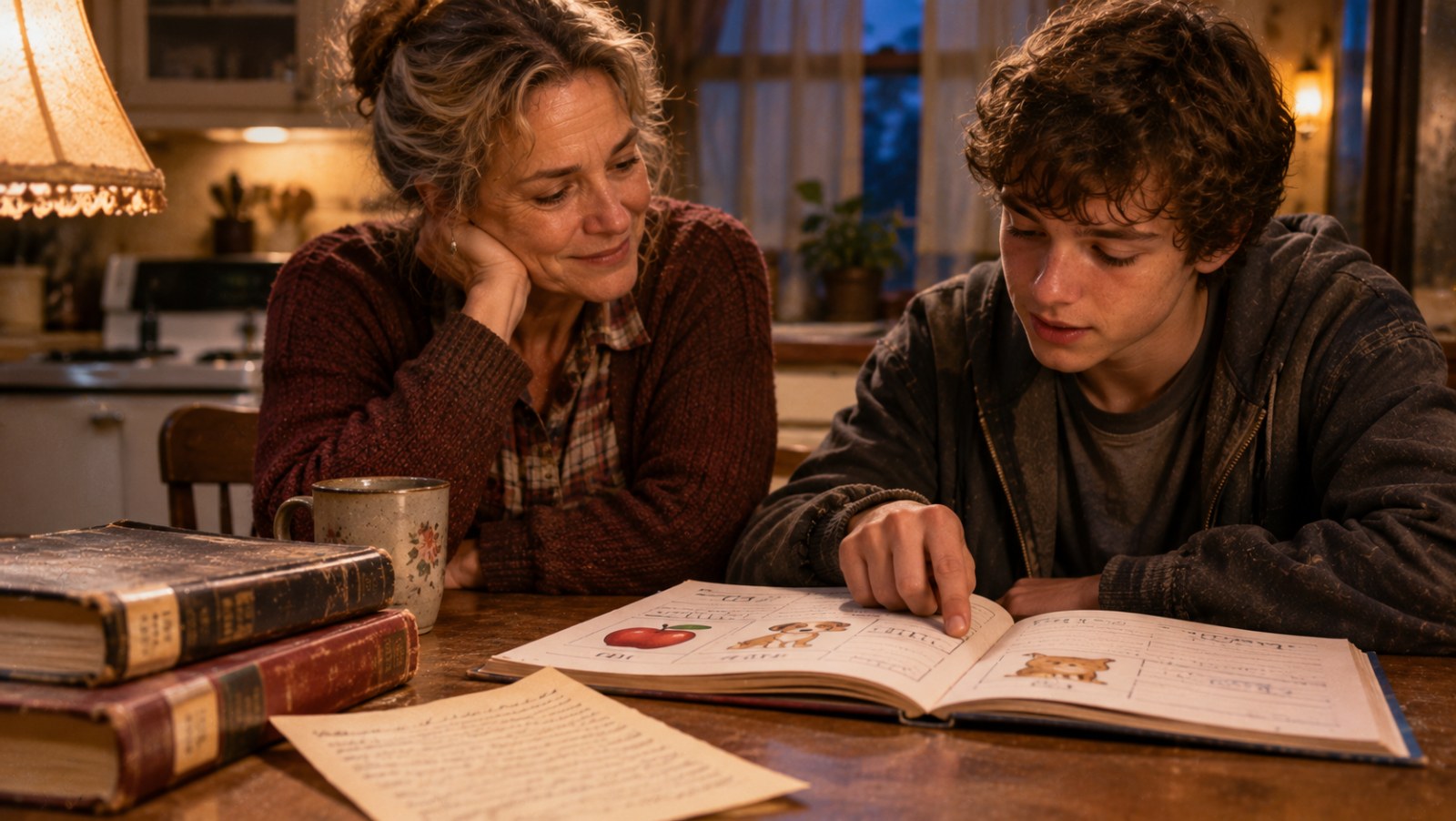
He ate two turkey sandwiches and a bowl of tomato soup at my kitchen table without saying much.
When he was done, he sat there for a while, looking at his hands. I could tell he wanted to say something.
“Marcus,” I said gently, “is there something I can do for you? Anything at all?”
He reached into the pocket of his hoodie and pulled out an envelope. It was creased and soft, like it had been folded and unfolded a hundred times.
“Can you help me read this letter?” he asked quietly.
I thought he meant it was in difficult language. Legal words, maybe. A notice from the city.
“Of course,” I said. “Let’s see it.”
He handed it to me. It was a letter from Bay View High School. Three sentences long. A notice that Marcus Webb was failing three classes and was at risk of not advancing to eleventh grade.
Simple words. Nothing complicated.
I looked up at him, confused. And then I saw his face.
He was red to the tips of his ears. He wouldn’t look at me.
And after thirty-four years of teaching, I understood.
“Marcus,” I said softly, “can you read?”
He stared at the table for a long time.
Then he shook his head.
He told me the whole story that afternoon.
His mom had moved them around a lot when he was little. Five schools before third grade. Every time he started to catch up, they moved again. By fourth grade, everyone else was reading chapter books, and he was still guessing at words from the pictures.
So he learned to hide it.
He memorized things he heard in class. He let other kids read out loud first. He got good at being the funny kid, the quiet kid, the kid who “forgot” his homework. Teachers thought he was lazy. He let them.
“I can do some words,” he said. “Short ones. Signs and stuff. But a whole page, it’s like… the letters move around. I get lost.”
“Does your grandmother know?”
“She can’t read either,” he said. “She grew up in Mississippi. She had to leave school in second grade to work.”
He looked at the wallet sitting on my table.
“I could read the numbers on your license. That’s how I found you. I can do numbers fine.”
I thought about all those twenties.
A boy who couldn’t read his own report card had picked up $600 off the street, walked two miles, and handed it back to a stranger.
And the only thing he wanted in return was to understand three sentences.
I closed the letter.
“Marcus, I want to make you a deal,” I said. “I was an English teacher for thirty-four years. I’ve taught a lot of kids to read. Some of them were older than you.”
He looked up.
“Come here after school. Monday through Thursday. I’ll make you dinner. And we’ll work on reading. No grades. No one else has to know.”
“Why would you do that?”
I held up the wallet.
“Because you could have kept this. And you didn’t.”
He showed up the next Monday at 3:45. And the next day. And the next.
We started with the basics. Phonics. Sounds. I pulled out old workbooks from boxes in my basement — the ones meant for second graders — and I tore the covers off so he wouldn’t feel embarrassed.
The first week was hard. He got frustrated. Twice he threw his pencil across the room. Once he got up to leave.
“I’m too stupid for this,” he said.
“You are not stupid,” I told him. “You found my house with nothing but a license and a map in your head. You’re the furthest thing from stupid I’ve ever met. Nobody ever taught you the code. That’s all this is. A code.”
He sat back down.
In October, he read his first full sentence out loud without stopping.
“The dog ran across the big green yard.”
He stared at the page. Then he read it again, faster.
Then he put his head down on my kitchen table and cried.
I cried too. I didn’t even try not to.
By Thanksgiving, he was reading short articles in the newspaper. By Christmas, he was reading the sports section to his grandmother every night. By spring, he’d read his first whole book.
It was “Hatchet,” by Gary Paulsen. A book about a boy who has to figure out how to survive on his own.
“This is me,” he said, when he finished it. “This whole book is me.”
He passed all three classes.
His English teacher called me in June. She’d found out about our afternoons. “I’ve had Marcus for a year,” she said. “I thought he just didn’t care. I feel terrible.”
“He cared,” I told her. “He just didn’t know how to ask.”
And then something happened that I didn’t expect.
Marcus brought his grandmother to my house.
Her name was Miss Lorraine. She was seventy-four years old, with a church hat and a purse she held in both hands. She stood in my doorway and said, “My grandson tells me you teach people to read.”
“I do,” I said.
“I’m seventy-four,” she said. “Is that too old?”
I opened the door wider.
“Miss Lorraine,” I said, “come on in. Marcus can help me teach you.”
That was two years ago.
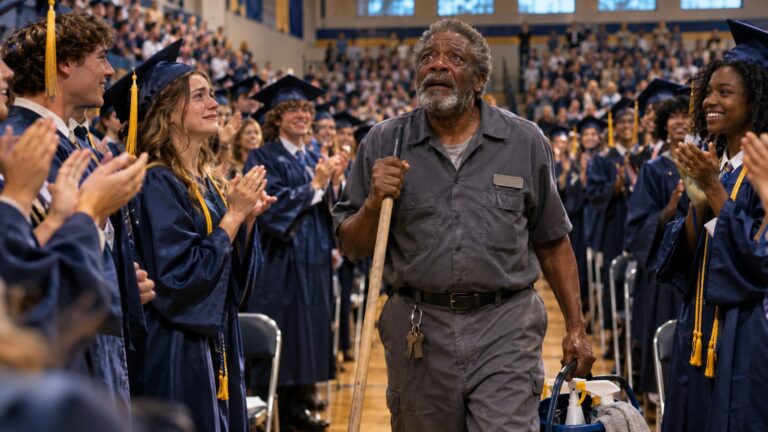
Marcus is eighteen now. He graduated from Bay View High School last month. I sat next to Miss Lorraine at the ceremony, and when they called his name, she stood up and shouted so loud the whole auditorium turned around.
This fall, he’s starting at Milwaukee Area Technical College. Electrical engineering. He reads all his own textbooks now.
Miss Lorraine reads her Bible out loud every Sunday. Slowly, but every word.
And Marcus? He volunteers at the library downtown on Saturdays. Teaching adults to read.
Last week, he sent me a photo. A grown man, maybe forty, sitting at a library table, holding up a children’s book and grinning like he’d won the lottery.
Underneath, Marcus wrote:
“He read his first sentence today. I told him what you told me. It’s just a code.”
THE END.
The kindest thing you can do for someone who’s struggling is make it safe for them to ask for help. >> If someone returned your wallet with every dollar inside, what would you want to do for them? Tell us in the comments.